
Estimated reading time : 2 min · Published October 1, 2026
Name the contributions you actually need
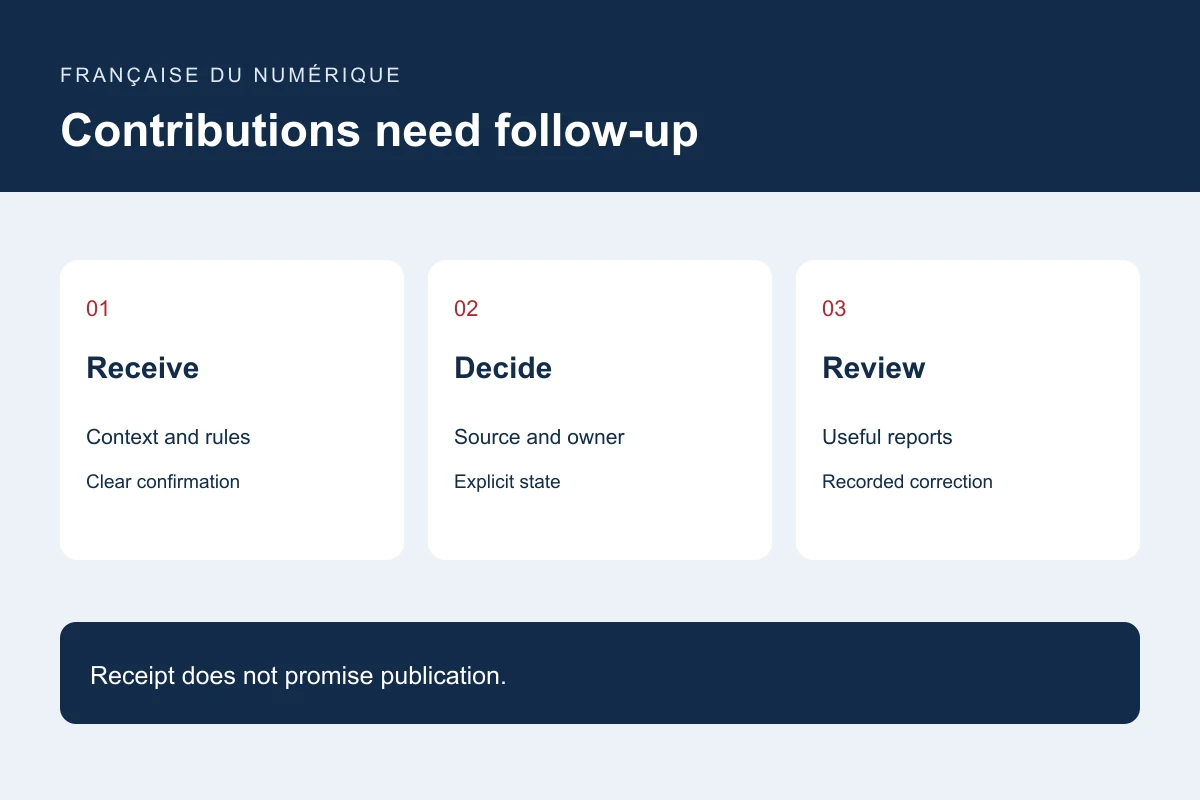
Explain what people may submit and why: correct a record, ask a question or supply an authorised testimonial. Omit fields no one can verify. Put understandable rules near the form, with examples instead of an abstract list.
Mozilla’s participation guidelines provide an example of an explicit behavioural framework, not a universal legal template. Adapt your rules to the audience and available moderators, and have service-specific obligations reviewed where needed.
Define a decision workflow
Choose useful states such as received, under review, published, refused or awaiting clarification. Define who decides and when a second reviewer is needed. Preapproval may suit some contributions, whereas immediate publication creates different monitoring needs.
Announce only response times the team can maintain. Receipt confirmation should not promise publication. For a directory, request a primary source and verify the proposed record before changing existing information.
Support proportionate reporting
Provide a way to report an error or problematic content from its context. Ask for the relevant address and explanation without requiring sensitive copies for a simple correction. Define a recipient and a process for time-sensitive reports.
Test a valid submission, incomplete request, repetition and lost notification. Check that refusals are understandable and one person’s contribution is not attributed to another. Keep acceptance examples synthetic rather than publishing simulated testimonials.
Retain a useful decision record
Record state, reason and owner while limiting stored information. Separate internal notes from material suitable for publication. Plan contribution correction or removal according to applicable rules and context.
Review difficult cases to identify missing information, unrealistic timelines and confusing steps. Deliver an owner-assigned receipt–decision–publication–reporting workflow with examples and stated limitations.
Primary documentation : Mozilla — Community Participation Guidelines.