
Estimated reading time : 3 min · Published October 1, 2026
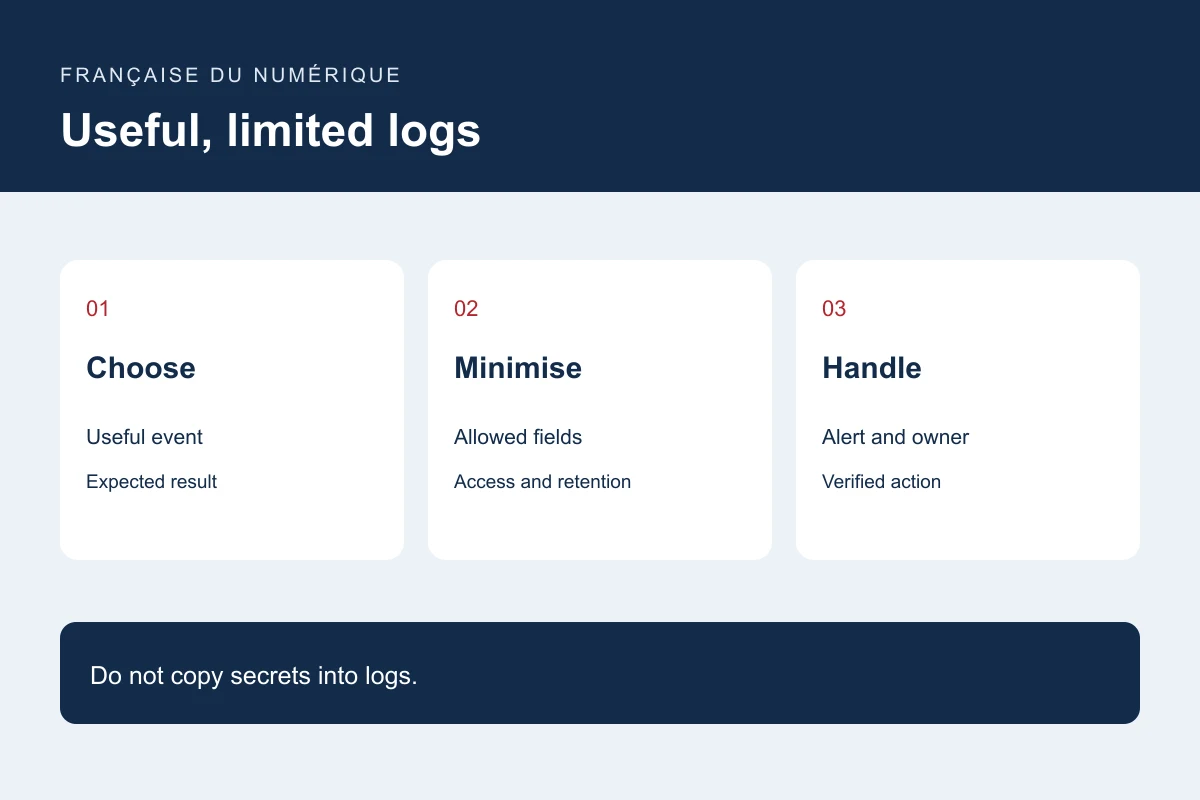
Start with questions the logs should answer
List operational questions: is a form failing, is a process interrupted, has a backup been tested? Define the event, component, time and an appropriate correlation identifier. Avoid messages that collect text without helping identify an action.
Prepare synthetic examples of success, refusal and failure. An expected refusal should be distinguishable from an outage. Event names and levels should help the owner decide whether to investigate or monitor a trend.
Minimise recorded information
OWASP discusses data that should be excluded from logs, including passwords, access tokens and sensitive information. Review messages produced by your code as well as plugins, proxies and monitoring services.
Use an allowlist of fields instead of copying an entire request. A diagnostic identifier may suffice where a full enquiry message would be excessive. Test with synthetic markers, then search outputs for those markers to detect unintended collection.
Manage access, retention and volume
Document who can read logs and why. Confirm they are not served from a public address or made accessible by sharing tools. A diagnostic export needs the same access review as primary storage.
Choose retention according to the actual need and applicable context rather than copying another service’s duration. Arrange rotation, volume limits and deletion. A repeated failure should not fill a disk through unlimited logging.
Test the path from signal to action
Trigger a controlled failure in a test environment. Check the log, alert delivery, recipient and response procedure. An alert sent to an inbox no one checks does not form an operational process.
Group repetitions and follow signals that support decisions. After an incident, review what was missing and what was unnecessarily exposed. A useful deliverable connects an event with minimum data, an owner and an action.
Primary documentation : OWASP — Logging Cheat Sheet.