
Estimated reading time : 3 min · Published October 1, 2026
Choose tasks before addresses
List uses such as finding a product, reading availability, updating a record or tracking processing. Define authorised people and systems for each operation. A public read API and an administrative API have different access requirements.
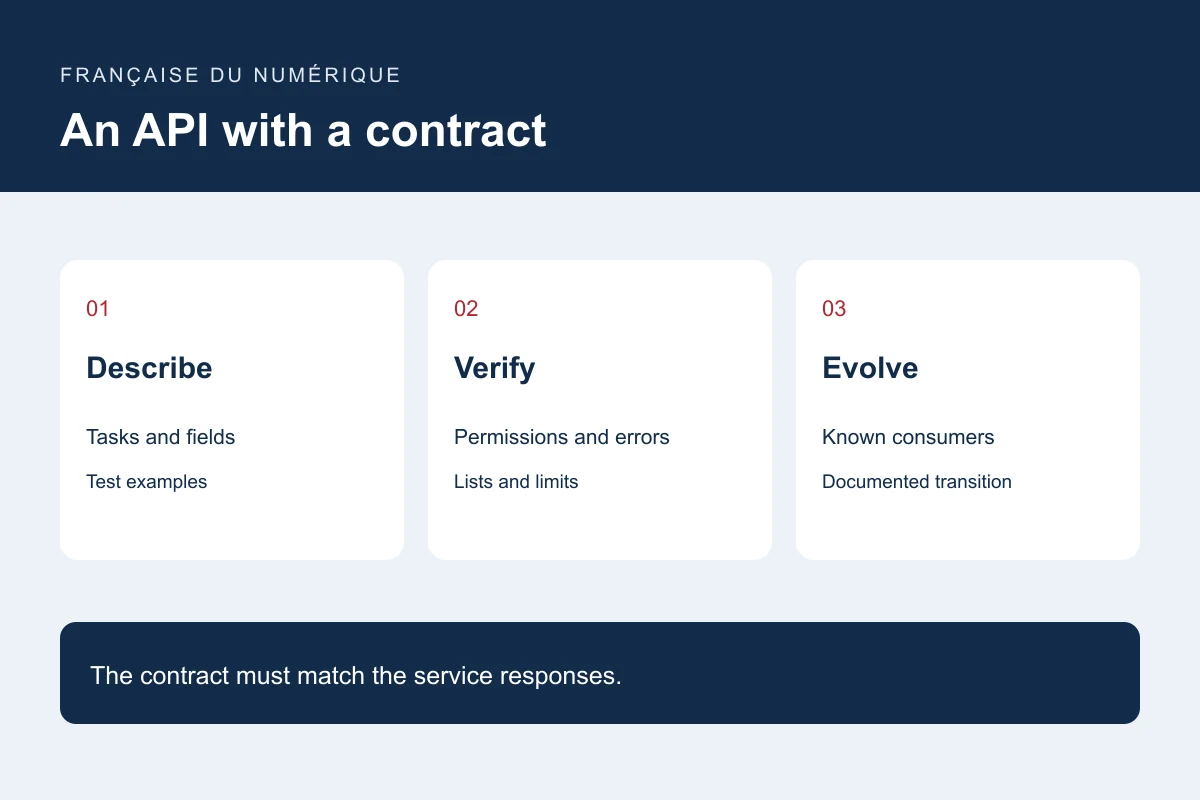
Prepare a request and response example for each essential task using synthetic values and explained fields. Distinguish stable identifiers, labels, units and dates. Define missing data instead of substituting plausible values for unknown information.
Describe an explicit contract
OpenAPI provides a language-independent description format for HTTP APIs, covering operations, parameters, responses and models. Choose a version supported by your tools and retain the document with the project; the newest version is not automatically the right fit for every toolchain.
Document usage limits, pagination, filters, ordering, errors and empty responses. Do not treat CORS as proof of authorisation. Review operation and object-level access controls with the technical team.
Test boundaries and permissions
Try an existing object, a missing object, an invalid parameter and a list longer than one page. Check the next page for losses or repeats within the chosen update model. State limitations that the API cannot guarantee.
Use test accounts with different permissions. Attempt reads and changes outside permitted scope using synthetic data. Record expected statuses and useful messages without exposing internal traces or configuration secrets.
Plan change and support
Distinguish an added field from a removed field or a changed meaning. Identify consumers before an incompatible change. Explain the transition period and how to detect integrations still using the earlier contract.
Deliver an executable example for a test environment, a test matrix and a technical contact. Relate observed errors to documented examples after release. Documentation limited to the ideal case leaves integrators without guidance for refusals and interruptions.
Primary documentation : OpenAPI Initiative — Specification.