
Estimated reading time : 3 min · Published October 1, 2026
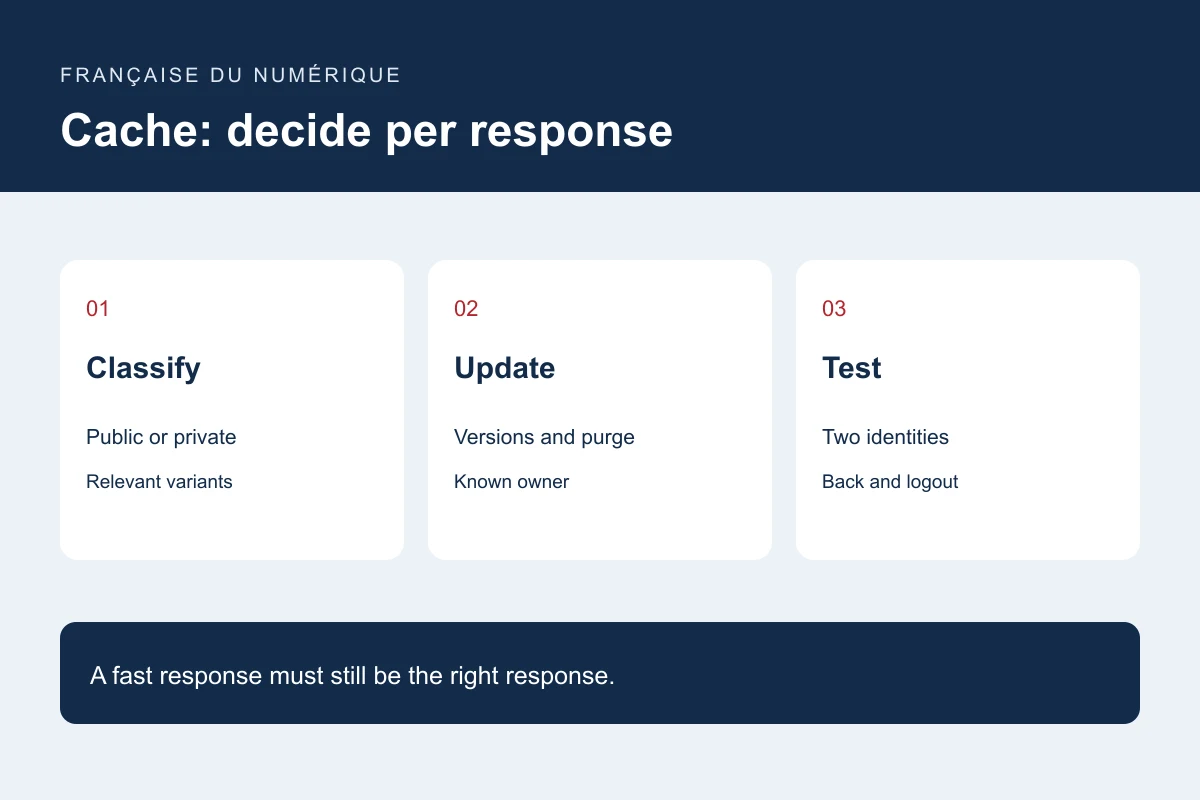
Classify responses before choosing a lifetime
Inventory public pages, static assets, API responses, accounts and confirmations. Record whether each changes with the user, language or a parameter. Identify browser, intermediary and CDN caches. An account page should not inherit the policy of a public photograph merely because that policy is easy to apply.
Distinguish freshness from permission to store a response. MDN explains that no-cache requires revalidation, whereas no-store requests no storage. private restricts storage to private caches. A cookie alone does not automatically make a response private.
Plan how an update becomes visible
Write an update rule for each family. For a versioned file, confirm that the new page requests the new URL. For a public page with a stable address, describe revalidation or purging. A long lifetime without a replacement procedure only moves the problem to the next content change.
Choose a practical example: a price correction, opening hours or a replaced document. Record when the origin changes, then inspect a session that has already visited the page. A fresh browser alone does not cover a returning visitor retaining an earlier response.
Test different identities and states
On a test environment, compare an anonymous visit, two distinct accounts, logout and back navigation. Inspect the displayed content and received headers rather than only the hosting configuration. Use synthetic test records instead of real personal documents.
Include relevant language, device, filter and error states. Keep the URL, session state, expected response and result for each test. When personalisation passes through a shared cache, have the infrastructure owner review cache keys and exclusions.
Keep a recovery procedure
Document who can purge the cache, verify its effect and restore a previous configuration. A broad purge may temporarily reduce caching benefits, so prepare a check of essential pages after the operation.
Review the policy when customer accounts, commerce, a language or a CDN is introduced. A useful deliverable is a response–policy–test–owner matrix. A performance score alone establishes neither freshness nor isolation between users.
Primary documentation : MDN — HTTP caching.