
Estimated reading time : 3 min · Published October 1, 2026
Establish provenance and scope
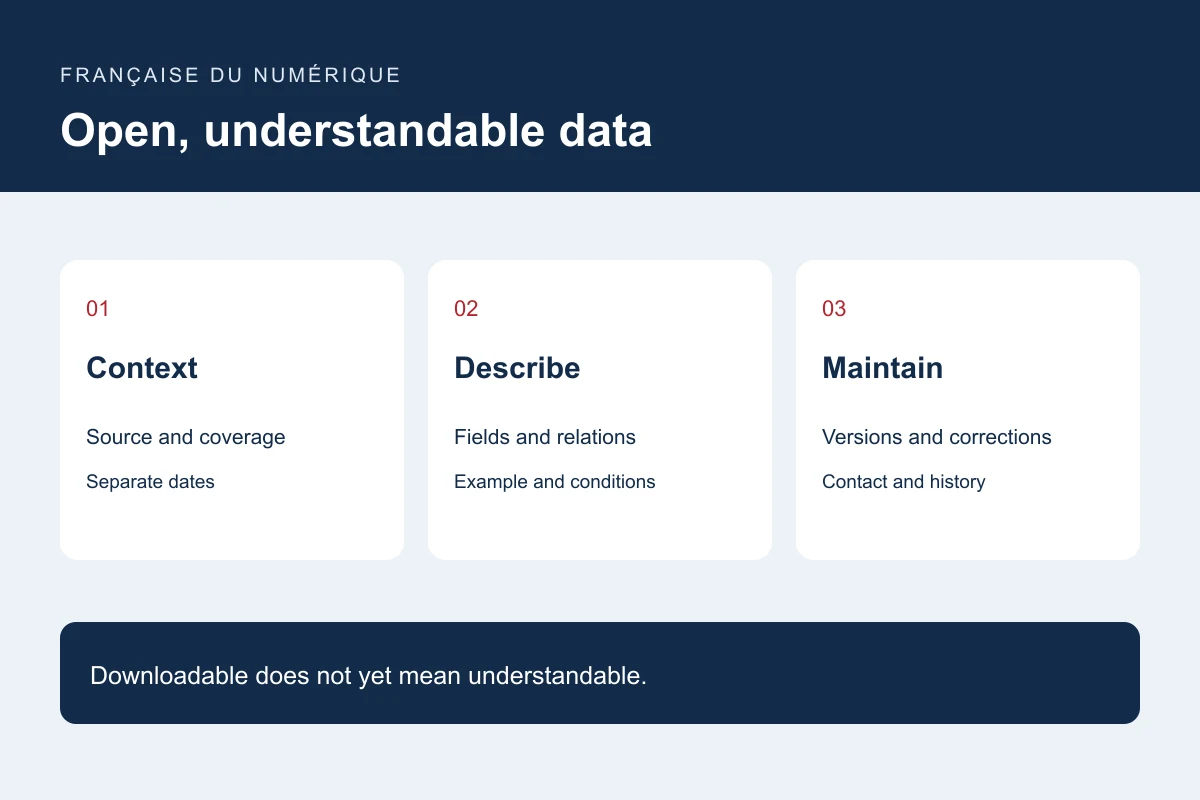
Describe producer, collection method, time period and geographic or thematic coverage. Distinguish extraction, update and measurement dates. A file published today may describe an earlier measurement; publication does not change its reference year.
State missing areas and approximate values where the source identifies them. Do not fill a gap with an undisclosed estimate. data.gouv.fr’s documentation guidance addresses production context, structure and possible inconsistencies.
Provide a dictionary and example
Explain each field, unit, type, missing value and reference code. Supply a small readable example consistent with the full dataset. Where identifiers join tables, document relationships and potentially unmatched rows.
Distinguish entities from their labels. A municipality may have several postal codes and a product several variants. Documentation should help prevent misleading aggregation or deduplication that removes a useful relationship.
Check publication and reuse
Identify source reuse conditions and attribution information to retain. Have appropriate reviewers assess publication rights and possible personal data before public release. An address visible elsewhere does not automatically make every copy suitable for publication.
Test downloads without internal tools or special accounts when public access is promised. Check format, encoding and integrity. Provide a version reference or checksum so feedback can be tied to the downloaded file.
Maintain versions and corrections
Choose a realistic review frequency and a contact for issues. Describe added, removed or redefined fields when schemas change. Distinguish corrections from new measurements to avoid creating false changes in a time series.
Retain useful versions and notes with a clear replacement policy. Publication documentation should let another person reproduce extraction or understand its limitations. A download counter does not replace documentation quality.
Primary documentation : data.gouv.fr — Bien documenter un jeu de données.