
Estimated reading time : 2 min · Published October 1, 2026
Define fields and their provenance
Document each entry’s entity type, identifier, official name, category, sources and relevant dates. A postal code does not uniquely identify a commune; a changing URL should not be a supplier’s only identifier. Fields need explicit definitions: headquarters or service area, fixed or variable price, publication or observation date.
For French administrative geography, Insee’s COG 2026 supplies names, codes and administrative relationships. The public administrative geography API exposes postal codes and population among other fields. Keep administrative edition, download date and a measurement’s reference year separate when known.
- Stable identifier and entity type.
- Field definitions.
- Primary source and licence.
- Effective, observed and review dates.
Check the whole dataset before correcting it
Count records, unique identifiers, missing fields and invalid formats. Detect exact duplicates, then investigate similar names, domains and codes. Two branches of one brand are not necessarily duplicates; two old URLs for one entry may be aliases. A merge therefore needs documented identity criteria.
Check relationships as well: a subcategory belongs to an existing category, a commune to its department and a product variant to its parent product. An external destination returning 403 or 429 may block automated tools; that does not prove it has disappeared. Keep such responses in a review list instead of deleting the entry.
- Unique identifiers.
- Valid categories and relationships.
- Formats, units and plausible values.
- Confirmed errors separated from uncertainties.
Add information that supports a decision
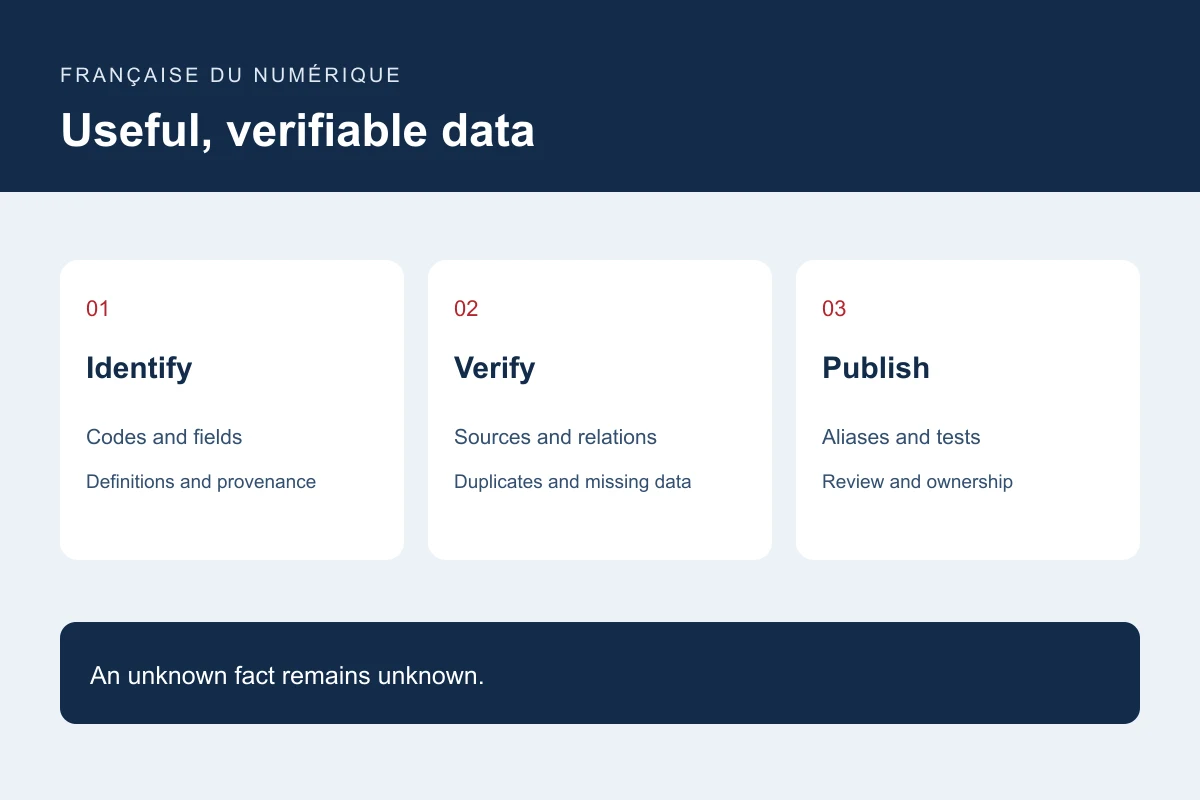
Fill gaps in the visitor journey: service purpose, intended audience, contact arrangements, useful characteristics, restrictions and official documentation. Verify and date prices, qualifications, hours and availability. An unknown value stays unknown; an average or illustrative value must not be presented as real.
For media, record the file, provenance, rights and role within the page. A monogram is preferable to an invented logo. An illustrative photograph does not portray a real business. The links and logos guide complements textual checks.
Publish while preserving useful old URLs
Prepare a backup, a difference report and tests before replacing data. Keep old names and slugs as aliases where entity identity is certain. A merged entry should lead to the relevant destination; removal without replacement should not redirect to an arbitrary page. Retest search, filters, counters and structured data after the change.
Assign an owner and review trigger to changing facts: renaming, closure, a new version or an expiry date. Report how many entries were added, corrected, merged or left to confirm. Long-term content operations make this work repeatable.