
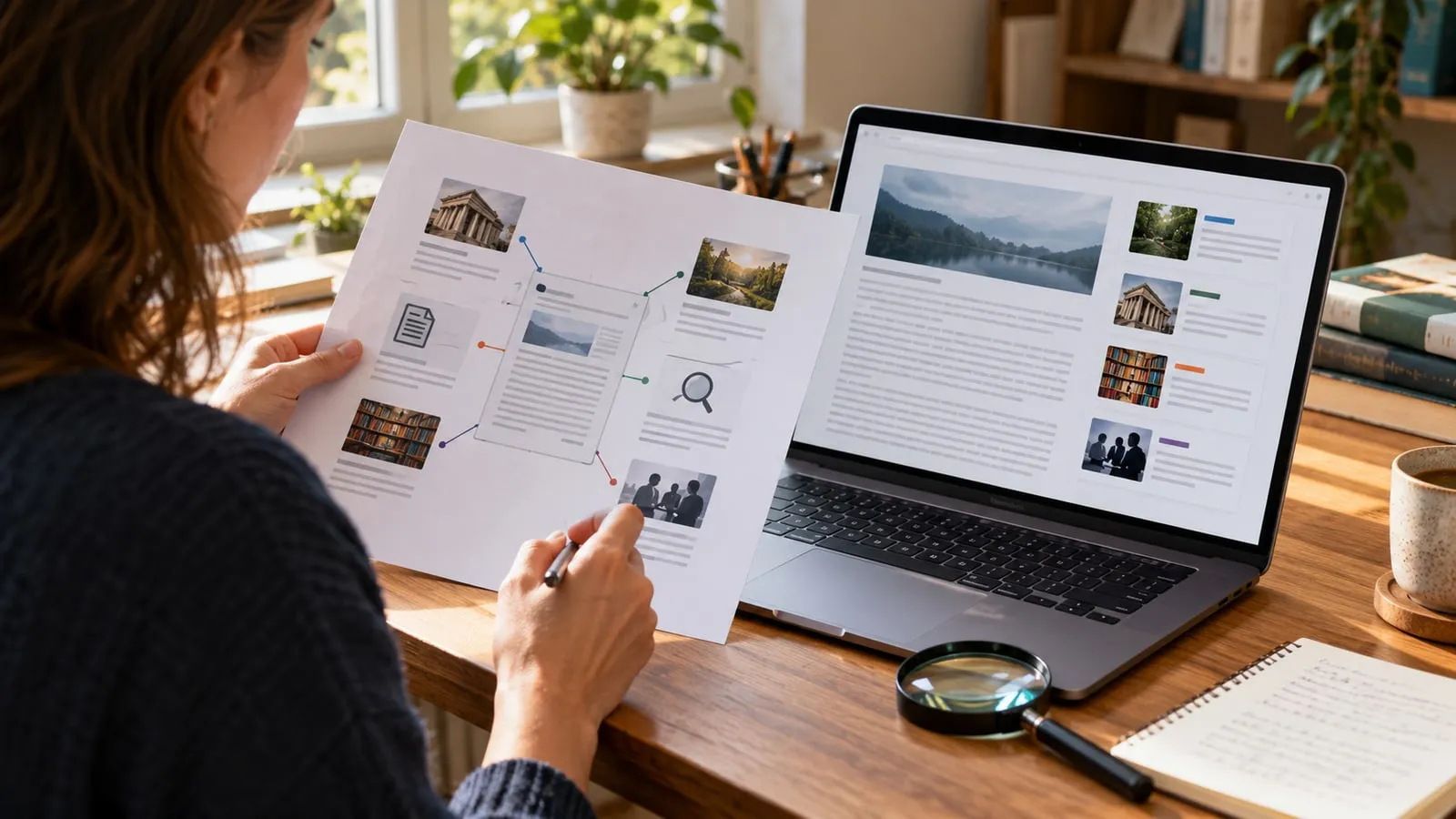
A source should allow you to verify an affirmation without guessing where to look. Link the proposal to the relevant document with an understandable wording, then check that the quoted content actually supports the text. The accessibility of references is part of the editorial quality.
Associate an assertion with a proof
During writing, note which passages are based on documentation, observation or fictional example. A home page is not always enough to support a specific rule. Open the document and check its scope: product, version, territory and date. If the source does not say what you write, correct the sentence or look for a more suitable reference.
Choose an understandable label
The W3C explains that the destination of a link must be able to be understood from its specific text or context. A specific document title or description helps more than a succession of “click here”. Also think of the reader who browses only the links. Report the format or language when they are useful to anticipate what will open.
Control the link between a sentence and its document
For each important statement, ask three questions: what passage supports it, in what scope and with what topicality? Product documentation may describe a limited option to some versions. A general article can explain a notion without justifying the precise conclusion you draw from it. The link should allow this verification, not just give a documented appearance to the page.
| point to check | Practical question | possible correction |
|---|---|---|
| Relevance | Does the document really support the sentence? | Rephrase or choose another reference |
| Perimeter | Do the version and conditions match? | Add applicable limits |
| Actuality | Is the document still the current reference? | Check the new documentation |
| Destination | Does the link open the advertised document? | Correct URL, redirect or advertised format |
| Wording | Does the reader understand the usefulness of the link? | replace a generic title with a description |
The W3C criterion on the link function Helps to design understandable navigation. The context of the sentence remains important, but a specific title also facilitates the consultation of a list of links. When the language or document format changes the expected experience, advertise it in a useful way.
Avoid decorative references
A long bibliography does not compensate for the absence of a link between the facts and the documents. Place a reference near the relevant passage and keep a short final list to deepen. Do not attribute to an author a conclusion that he does not formulate. If you propose a method from your reasoning, present it as a proposed method, even when it is based on technical documentation.
Fictitious example: a redirect rule
An article describes a server behavior and quotes a general post on the redesign. The writer replaces this reference with the relevant documentation, specifies the technical condition and adds a test example. He then checks the link on the keyboard and on mobile. The reader thus has the necessary context to control the assertion without getting lost in another site.
Review the reference editorially as well as technically
- Open the document with the same URL as the published one. A page accessible from your history or your account does not prove that the public link is working.
- Read the passage concerned and its conditions. A destination can remain active while having changed subject or version.
- Control keyboard and mobile links. Check that the label remains understandable and that the opening does not depend on a fragile interaction.
- Note the references to review with the next evolution of the subject. Product characteristics and interfaces often require different tracking from a stable definition.
In a fictional example, an article links an explanation of canonicalization to a general post on the redesign. The ticket can be interesting without supporting the technical rule. The correction is to cite the relevant documentation near the statement and to explain the conditions. It does not consist in accumulating other links at the end of the page until making the bibliography longer.
The final list can keep the main documents and complete the links embedded in the text. it must remain proportionate to the subject. One Register of audited facts Helps find the affected items when a source changes. For multilingual content, also check that the translated labels advertise the documents correctly, even when they remain in their original language. The existence of a link never replaces the verification of what it proves.
When the pages exist in several languages, the SEO location acceptance test Completes reference control. In particular, it verifies the meaning of the terms, the links between versions and the documents that remain in another language.
Maintain references
During a review, control Status, Redirects, and Destination Content. A still active URL may have changed subject. Keep the verification date and the reviewer responsible. Broken links require an editorial correction, not just an automatic substitution. Integrate this control into your Link repair routine And verify that citations remain readable in snippets and share formats.