
Estimated reading time : 2 min · Published October 1, 2026
Start with a task and a framework
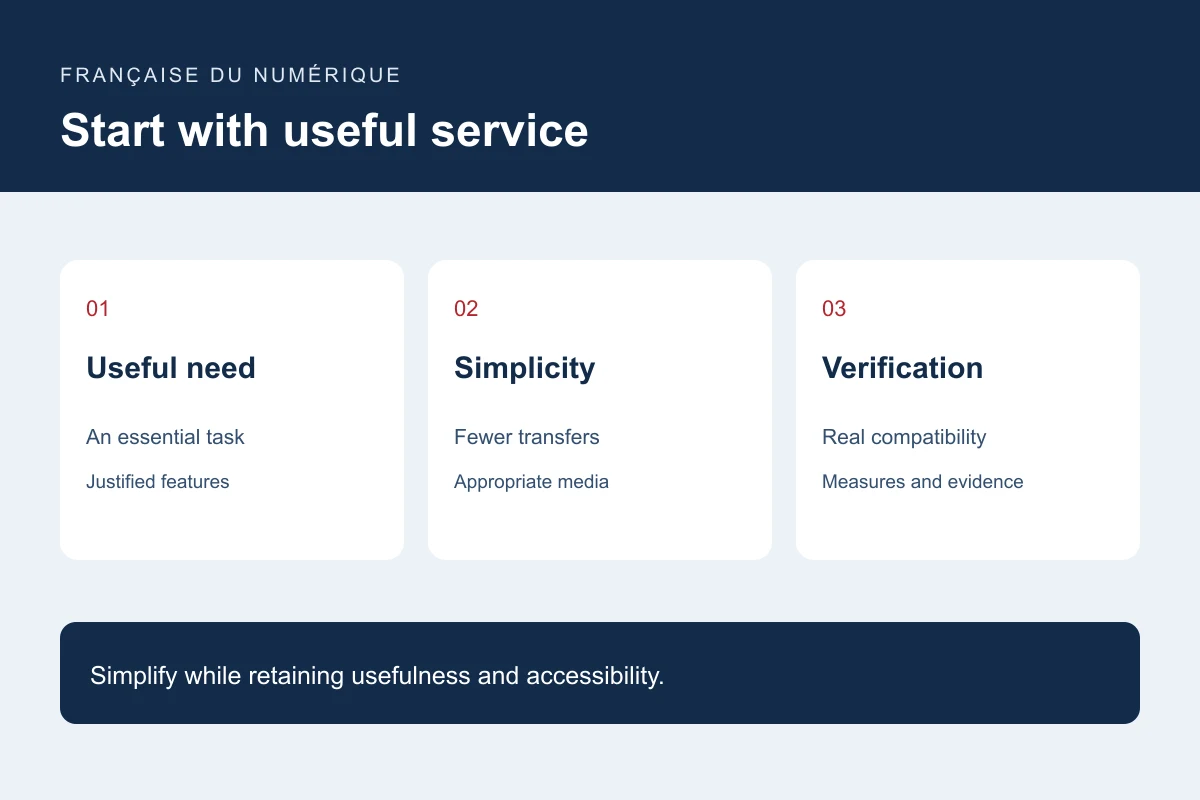
Write down the essential task: find opening times, compare a service, book or send an enquiry. Ask whether each feature helps that task and whether a simpler solution delivers the same service. An animated carousel or decorative video may add transfers and constraints without useful information.
The RGESN introduced by Arcep provides a technical framework for digital-service ecodesign. Select applicable criteria and document responses. Consulting the framework does not certify a website.
- Useful task.
- Audience and equipment.
- Features that can be simplified.
- Applicable criteria and evidence.
Reduce transfers across the actual journey
Measure resources downloaded when a visitor opens the page and completes the action. Examine images, fonts, scripts and third-party services. Use suitable dimensions, efficient formats and deferred loading for off-screen elements. A light initial page may become expensive if it preloads many destinations or calls unused services.
Match caching to update frequency and reduce repeated requests. Organise long lists meaningfully or use accessible pagination. Removing a feature people need solely because it consumes resources is not sufficient reasoning: compare its usefulness with alternatives.
- Weight and requests per task.
- Images sized for their display.
- Justified third-party services.
- Outdated content and avoidable downloads.
Test compatibility and trade-offs
Try the journey on less powerful hardware, a slow connection and with keyboard navigation. Compatibility may prevent a simple task from requiring newer equipment. Check zoom, error messages and layout stability; reducing weight must not make information inaccessible.
Overcompressed imagery may hide a product detail needed for comparison. Removing a font may improve loading while changing the visual identity. Record each trade-off’s observable effect, maintenance cost and reversal method if the experience worsens. The performance and accessibility guides explain complementary checks.
Publish a verifiable approach
Retain objectives, scope, baseline measurements, changes and limitations. For a reduction claim, specify what was measured: transferred bytes, requests or response time in a defined scenario. Page weight alone cannot establish a certain carbon footprint; such an estimate needs wider scope and explicit assumptions.
A declaration should make criteria and evidence understandable. Arcep provides an example ecodesign declaration. Reassess after adding video, another language or an integration. The approach concerns an evolving service rather than a frozen page.